
Last updated November 2026
A scaffold must support its own weight plus at least four times its maximum intended load (OSHA 1926.451(a)(1)). Typical duty ratings are 25, 50 and 75 pounds per square foot, but the scaffold’s design and rating set its real limit.
Planning heavy loads on a NYC scaffold?
This page explains public rules. It is not engineering advice. A competent person or a registered design professional decides the loads for a specific scaffold.
Most confusion on this topic comes from mixing jurisdictions. Here is who wrote each rule.
| Rule | Where it comes from | Applies in NYC? |
|---|---|---|
| Support own weight plus 4 times the maximum intended load | OSHA 1926.451(a)(1), federal | Yes |
| Suspension ropes hold 6 times the load on them | OSHA 1926.451(a)(3), federal | Yes |
| Light, medium and heavy duty ratings (25, 50, 75 psf) | OSHA Appendix A to Subpart L, advisory | A reference scale, not a mandate |
| 75 psf as a permit threshold for supported scaffolds | NYC Building Code, BC 3314.2 | Yes, in NYC only |
| Restrain a scaffold taller than 4 times its base width | OSHA 1926.451(c)(1), federal | Yes |
| 3:1 working height to base | Ontario Guideline No. 23, Canada | No. Some employers adopt it as a stricter habit. |
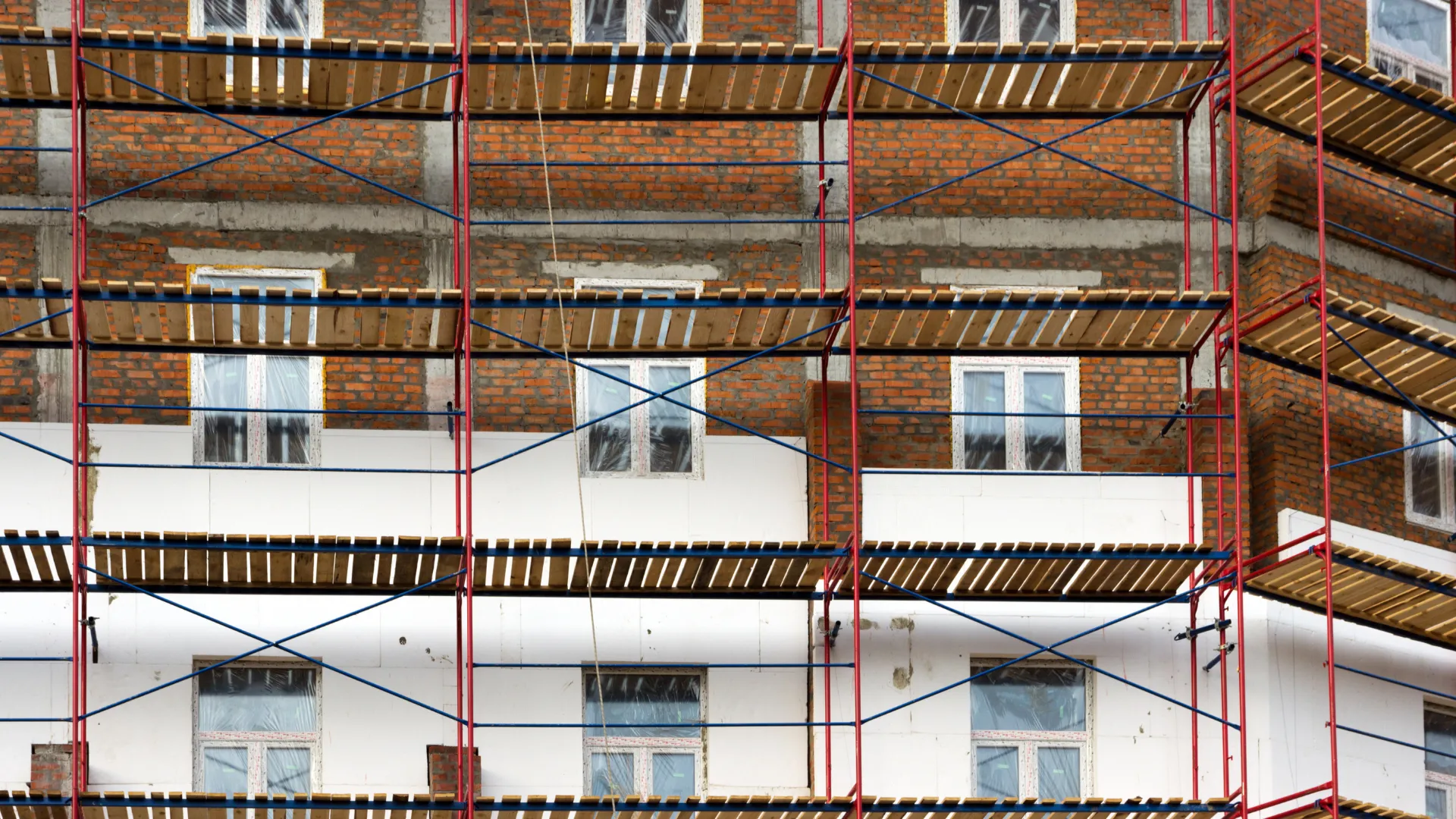
A scaffold has no single weight limit, because the load depends on the design, the rating and what sits on it. OSHA sets the minimums in 29 CFR 1926 Subpart L.
OSHA defines it as the total of all people, equipment, tools, materials, transmitted loads and other loads reasonably anticipated on the scaffold at one time. The count includes everything, not only the heavy items.
Each scaffold and each component must support, without failing, its own weight and at least four times the maximum intended load. That margin is the safety factor.
Each suspension rope must support at least six times the maximum intended load applied to it.
No one may load a scaffold beyond its maximum intended load or its rated capacity (1926.451(f)(1)). So the number that matters is the one on the scaffold’s own design, not a figure from a chart.
OSHA’s Appendix A is advisory, and it sorts scaffolds into three duty ratings. Each rating assumes a load spread evenly across the span.
| Duty rating | Uniform load |
|---|---|
| Light duty | 25 pounds per square foot |
| Medium duty | 50 pounds per square foot |
| Heavy duty | 75 pounds per square foot |
The appendix is non-mandatory, so treat it as a reference scale. Jobs that stack stone, block or stored materials on a platform tend to push toward heavier ratings.For example, a pallet of bricks stacked in one area can concentrate weight on a few planks. The average load across the platform may look acceptable while the concentrated load exceeds the capacity of those planks.
NYC adds its own thresholds. Under BC 3314.2, a supported scaffold skips the DOB permit only if, among other limits, its design load stays at or under 75 pounds per square foot. A registered design professional designs supported scaffolds under BC 3314.3.1, with exceptions for light-, medium- and heavy-duty scaffolds that stay within set limits.
Loading masonry or materials? Tell us what goes on the platforms when you ask for a quote.
These two rules sound alike and come from different places. Neither one is a weight limit.
A supported scaffold with a height-to-base-width ratio of more than 4 to 1 must be restrained from tipping by guying, tying, bracing or an equivalent means. A scaffold 20 feet tall on a 5-foot base sits right at the line.
Ontario’s film and TV industry Guideline No. 23 says a freestanding tower’s working height should be three times its narrowest base side at most. Above that, the tower must be secured to a structure or braced with guy wires. It’s a Canadian guideline for one industry, and it is not US law.
OSHA’s 4:1 rule applies. Some employers choose 3:1 as a stricter practice, and that’s their policy, not a legal requirement.
OSHA doesn’t publish an official list of five. These five are core requirements from OSHA’s scaffold standard, 29 CFR 1926.451.
OSHA defines a competent person (1926.450(b)) as someone who can identify existing and predictable hazards and has the authority to take prompt corrective action.
Three habits prevent most load problems before the first plank goes down.
Before a crew loads a platform, ask:
A provider who can answer all five is doing the job right. We don’t state load ratings for our own equipment on this page, because the design for your job sets the number.
No single number applies. OSHA requires a scaffold to support its own weight plus at least four times its maximum intended load. Duty ratings of 25, 50 and 75 pounds per square foot give a rough scale, but each scaffold’s design and rating set its real limit. Full answer: how much weight a scaffold has to hold.
It’s the total of everything reasonably expected on the scaffold at one time: people, tools, equipment, materials and any loads transmitted to it (29 CFR 1926.450(b)). Count it before anyone loads a platform, because the safety factor builds from it. Full answer: how much weight a scaffold has to hold.
A supported scaffold whose height is more than four times its base width must be restrained from tipping by guying, tying, bracing or an equivalent means (OSHA 1926.451(c)(1)). It’s a stability rule about height and base width, not a weight limit. Full answer: the 4:1 rule and the 3:1 rule.
The 3 to 1 rule comes from an Ontario, Canada guideline for the film and TV industry, not from US law. It says a freestanding tower’s working height should not exceed three times its narrowest base side unless it’s secured or braced. Full answer: the 4:1 rule and the 3:1 rule.
OSHA doesn’t publish an official list of five. Five core requirements from 1926.451 come up most: capacity, firm footing, full planking, safe access with fall protection, and inspection by a competent person before each shift. Full answer: five core OSHA requirements.
Contact Hitech Sidewalk Shed & Scaffolding with the property address, building height and what you plan to put on the platforms. We’ll discuss the setup, while your competent person or registered design professional determines the allowable loads.